My Research
A short overview…
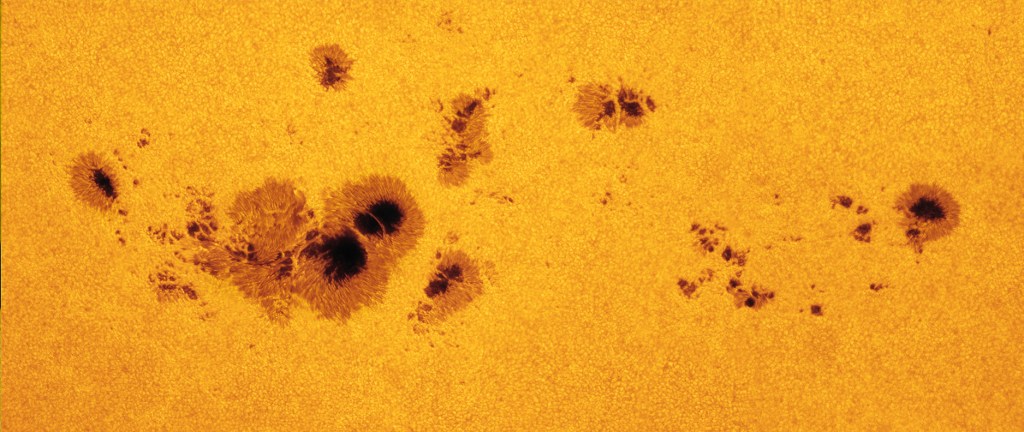
Stars with strong magnetic activity often exhibit prominent surface features known as starspots, which are analogous to sunspots on the solar surface. These features can follow cyclic patterns; for example, the Sun undergoes an approximately 11-year activity cycle. This cycle is driven by the periodic reversal and regeneration of the Sun’s global magnetic field—an effect known as the solar dynamo. The underlying mechanisms include differential rotation (the variation in rotational speed with latitude) and convective motions (the cyclic movement of plasma beneath the solar surface).
Though complex, these phenomena offer valuable insights into the behavior of magnetic fields in stellar interiors and throughout the universe. A more detailed review can be found here.
A comprehensive study of stellar activity
Studying stellar activity not only deepens our understanding of stellar magnetic processes, but also plays a crucial role in accurately characterizing stellar systems. Surface features such as starspots can introduce signals that mimic those of additional companions—such as other stars or exoplanets—leading to increased uncertainty in the determination of orbital and stellar parameters.
As illustrated below, we reconstructed the surface structure of the RS CVn-type binary system λ-And using the Doppler imaging code iMAP.

Through the analysis of long-term radial velocity data, we identified a stable spot configuration. In parallel, we measured chromospheric activity levels, providing a third dimension for examining temporal changes in the system’s activity.
Combining these diagnostics allowed us to model the radial velocity jitter induced by stellar activity and ultimately derive the most precise orbital solution for this system to date—one that is effectively corrected for activity-induced noise.
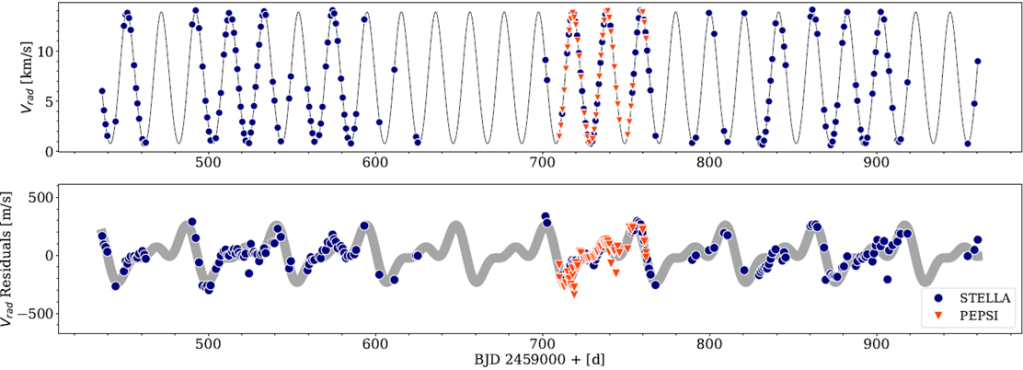
In addition, we analyzed magnetic field measurements obtained in multiple epochs (2017, 2022, and 2024). By combining our results with previously published data from other studies, we provided stronger evidence for the presence of an activity cycle in the star, estimated to span approximately 14 years. More details are here!
DISTRACT ( DIsentangler for STellaR ACTivity)
Quantifying stellar parameters and magnetic activity for cool stars in double-lined spectroscopic binaries (SB2) is not straightforward, as both stars contribute to the observed composite spectra and are likely variable.
For this purpose, we developed a spectroscopic analysis code (DISTRACT) tailored to double-lined spectroscopic binary (SB2) systems, in which both stellar components are directly observable. Using this software, we disentangled the composite spectra of an SB2 system, enabling a component-resolved analysis for each star.
This approach allows for a more detailed and accurate determination of stellar parameters and activity indicators, which is essential for our ongoing studies of activity-related variability in binary systems.
The figure below shows one of the key results of this work:
(a) The disentangled spectra of both stellar components (red and black lines) displayed with a vertical offset, together with the observed composite spectrum (blue line). (b) Phase-folded time-series spectra in the rest frame of the primary star, where the orbital motion of the secondary component is clearly visible.

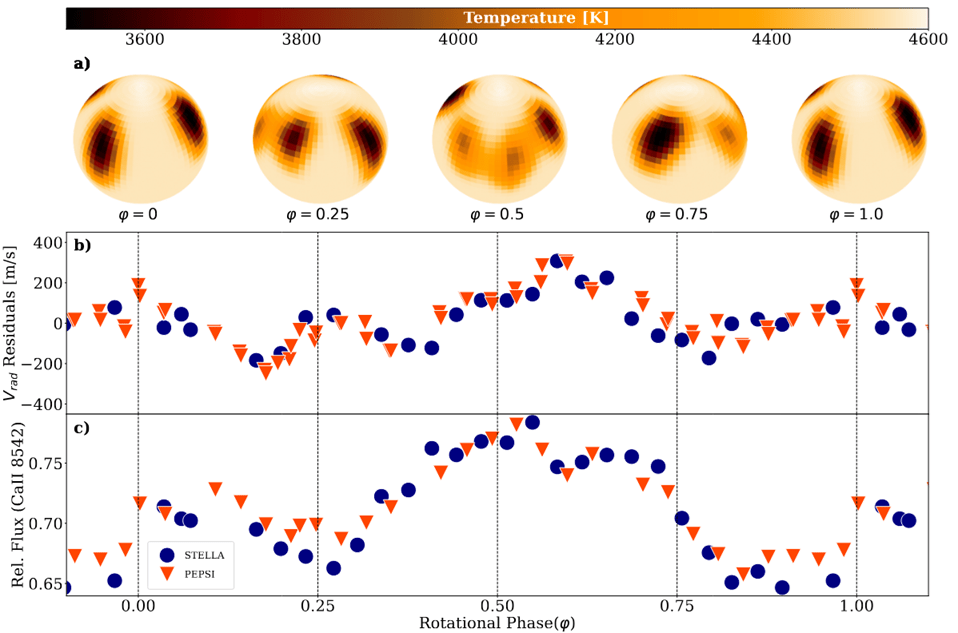
Once the spectra of both components were disentangled, we extracted the activity diagnostics of the primary star. The resulting surface reconstruction of HR 7275a, along with the corresponding activity-induced radial-velocity variations and chromospheric emission signatures, is presented below. Additional details can be found here.
From Sun-as-a-Star to Star-as-the-Sun
Doppler images provide important insights into where active regions are located on stellar surfaces and how magnetic activity shapes them. But can we go a step further?
If these surface structures behaved like solar active regions, what would the chromospheric emissions and radial velocity variations look like? What can we learn further about the system?
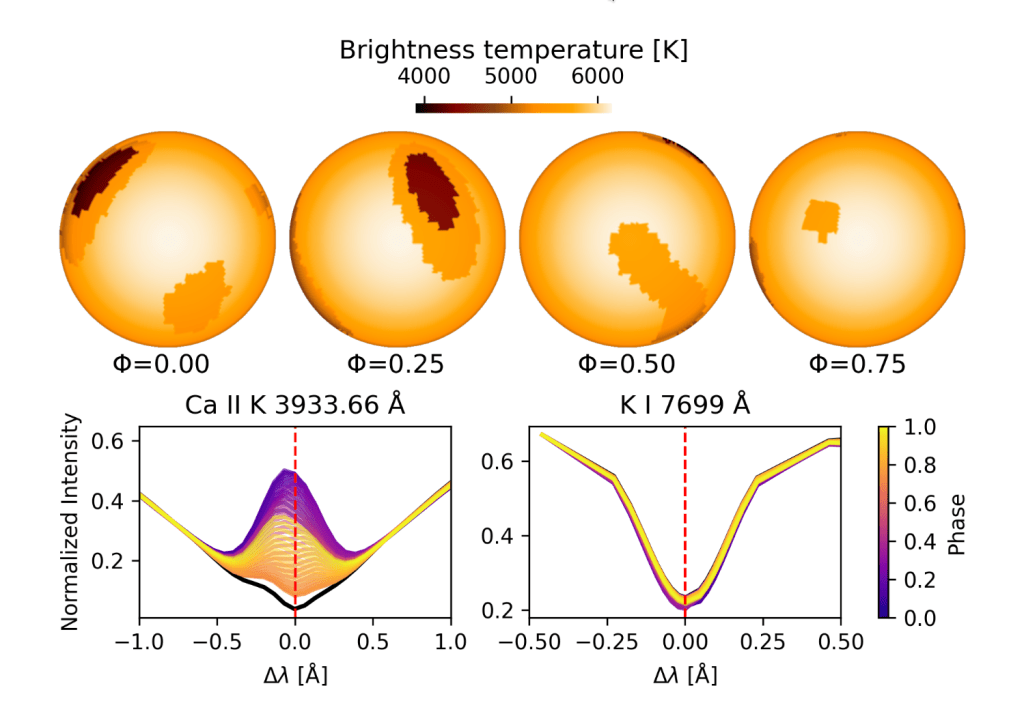
To answer these, we investigate the link between surface structures and magnetic activity in the active giant star λ And, focusing on whether observed activity variations can be reproduced from surface information alone. Using Doppler imaging temperature maps over a full stellar rotation, we forward modeled disk-integrated spectra with the NESSI code, adopting solar spectra as a simplified proxy for spotted regions. From these synthetic spectra – as shown in the last plot – we derived photospheric and chromospheric activity indicators and radial velocities, which we directly compared to simultaneous observations of the star. In the image below, the selected areas on the solar surface are indicated with white and red contours, separating the active regions as umbra and penumbra together with the quiet Sun.
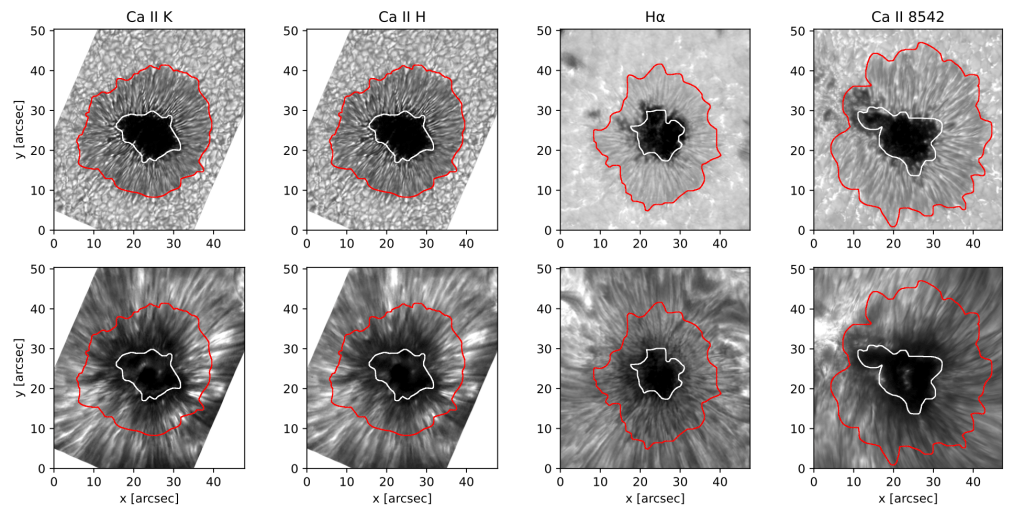
We find that this forward-modelling approach reproduces the overall modulation of the observed chromospheric activity remarkably well, indicating that magnetic active regions associated with starspots dominate the variability. At the same time, systematic differences between the model and observations point to additional heating processes in the chromosphere of evolved giant stars that are not captured by spot-driven variability alone. By using this method, we can confirm the relationship between the active region and observed activity indicators for this type of binaries and we will be able to investigate the time series activity modulation in much detailed way; which means to detect differential rotation rates at both photosphere and chromosphere of the stars. More details can be found here!
The follow-up papers in this series are currently in preparation.